


Author: Abdallah Hammad.
Imagine that your favorite restaurant suddenly closes overnight, just because the chef lost the cutting knife! And worse yet, the soonest they could get another one was several months later! ... In the 1970s, such a problem wasn't fictional! But it had more to do with manufacturing than restaurants.
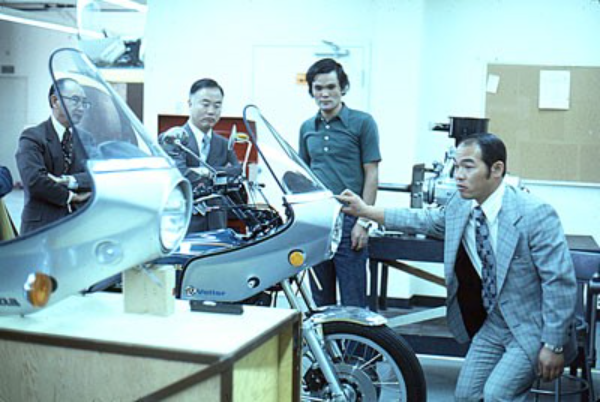
True story: the Vetter factory, which made accessories for Honda motorcycles in the USA, was damaged by fire in 1977. It lost its "molds" and could no longer make any new parts, just because it lost some manual, old-school tools. Molds were the parts onto which the metal was shaped to make motorcycle body parts. Just like the popsicle molds kids use to freeze homemade ice cream. (Also: the wooden spoon you use to shape Maamool, the Arabic sweet, is a mold. Imagine losing that on Eid night!).

Old ways of manufacturing included so many manually made parts and relied so heavily on human skills that a lost part or an unskilled worker could bring a production line to a standstill. Luckily, though, we now live in times of rapid prototyping and fabrication. Computer-aided design and manufacturing are what bring trendy accessories from the designer to the factory, to Shein, and then to your doorstep in a few weeks. Digital is the keyword here.
Even in Jordan, it’s what allows local companies to make a living by designing electronic circuits that are manufactured in China and integrated into devices sold in Europe. The design and project management are all done using computer software.
For STEM programs’ designers, this raises the question of whether education should adopt a fully digital toolkit for design and prototyping. It sounds reasonable to train learners on tools the market has adopted.
Should we completely ditch pen and paper and use a 100% digital toolkit when introducing kids to prototyping and product design?
Our experience showed otherwise! Trainers sometimes found the students disconnected and suddenly quiet ... or questioning, "What is all this gibberish?" while looking at the 3D-modeling screen. That's a trainer's nightmare.
Even after experimenting to rule out other potential causes, we still observed occurrences of less creative (than expected) and less inspired kids when the toolkit was fully digital.
It's important to mention that at YIL, sessions are designed with high student involvement and active learning as a priority. The quality standard is high. Sessions must get the kids excited, inspired, and producing ideas, while learning by implementing, evaluating, and improving on their ideas. We then use that to reflect and analyze within an experiential learning cycle.
Could the full digitization of the toolkit be the cause of less-than-expected student response?
Even advanced educational systems, like those in Finland, are still studying this topic. The question is out there, but a single, comprehensive, final answer isn't yet.
We took “yes” for an answer for the specific audience of YIL Amman (10 to 13 year olds with no prior experience). The following is the alternative we tried, the results, and a brief analysis.
Classical techniques such as cardboard modeling and manual sketching were re-introduced in the early ideation and conceptualization phase. This aimed to help students learn more actively and independently.
Cases:
1) Project: Insulin dose calculation assistant.
Challenge 1: Designing the hardware of a home appliance, including its inner mechanisms, outer structure, and cover.
As the students tried to design a device that contains many electronic components and carries food plates, communicating their ideas directly in TinkerCAD or other 3D-modeling tools wasn’t easy. They sometimes lacked the words to describe what they wanted to create or couldn’t imagine how a shape could be made from basic geometries. On the contrary, handing them some cardboard and stationery resulted in a tangible 3D model of the initial design.
.gif)
Then, it was possible to guide them on how to model it in software and 3D print it to fit electronics onto it and test its functionality. What comes next? If you’ve guessed the next iteration of the design, then you’re right. It was much easier, though.
Now compare the above-mentioned first cardboard prototype to the final 3D-printed plastic prototype displayed at the project exhibition.
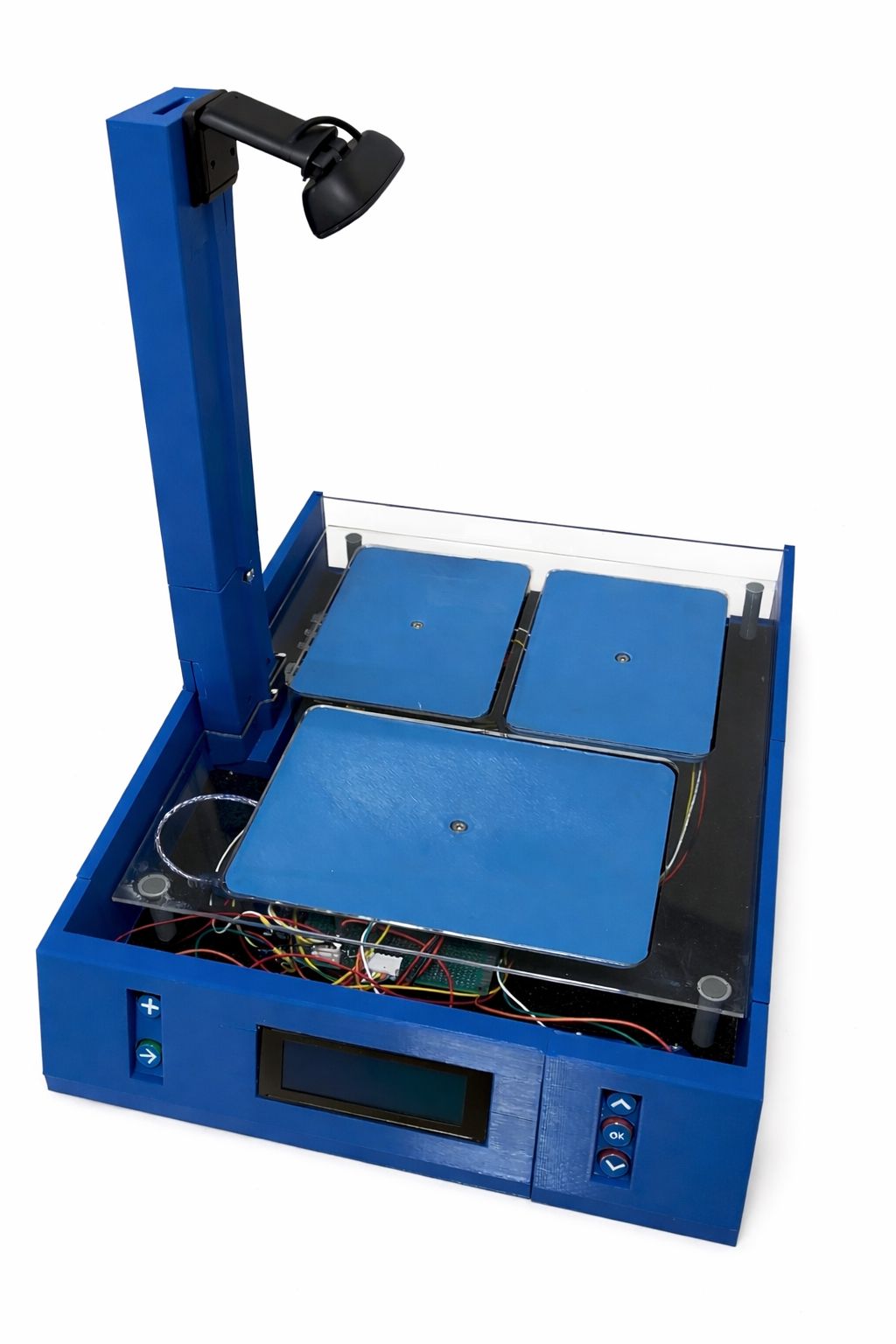
Challenge 2: Arranging multiple electronic components and circuits within a constrained area inside the device while maintaining easy assembly and repairability.
The design brief stated that the electronics should fit under the plates, be easy to assemble, and be easy to dismantle. Space was limited, and certain items had to be closer to each other. In technical terms, there were too many decisions to make with very little information (or skill) to base them on. The learners were given full-size paper templates placed on foam board, with a simple sketch of the base, onto which they tried different layouts for the positions of the electronic components within the available space. Discussion followed about ease of assembly, maintenance, and the stability of moving parts.
2) Project: Robotic farming assistant
Challenge: Despite zero previous exposure, design a hardware mechanism that removes unwanted weeds from farmland with high precision.
Mechanism design by 12 year olds? No easy task, especially when they’ve never known what a gear or lever is! So, we started with Lego-like metal parts, which they used to visualize their ideas of how weeds could be removed from the ground. They mimicked scissors or drill bits. Then came guided discussion and experimentation about what requires more motor torque, what is more precise, and what is easier to assemble. The aspects on which a mechanism is evaluated and selected were easier to discuss this way.
.gif)
Analysis and Discussion:
A few observations are no source for a confident recommendation. Do the mentioned attempts align with any theory on student experience and learning quality?
The above-mentioned attempts, described in more technical terms, could have:
- Reduced the barrier of entry for learners exploring materials, dimensions, and shapes.
In casual terms: you could point on a screen and say the structure would be weak. But you could let the kids load the structure with a weight and see for themselves if the cardboard holds.
- Facilitated communication and visualization of ideas, relying only on existing craft skills without asking kids to learn new software skills.
In casual terms: They could have lovely ideas that make sense as mechanisms or structures but pointing at thin air or trying to de-construct then building them using a mouse and lines on screen would be difficult. On the other side, grabbing scissors and shaping them by hand out of paper would let the learner present a tangible sample of their idea.
- Allowed for more sensory interaction during the learning session, which should provide an enhanced experiential learning journey. (via a smoother journey toward reflection, analysis, … etc.)
(tangible doesn’t equal experiential, but it allows for a step along the path)
- Provided early feedback through the material's aesthetics and performance characteristics.
In casual terms: Dimensions become less tangible on screen, but a manually drawn line holds dimension and weight visible to the naked eye.
Closer to the senses is closer to the mind to grasp, and easier to build on. Literally!
In later stages, higher adoption of digital tools could make sense. But specifically for this case, the simpler tools matched the learners’ existing skills and abilities, and simplified the ideation and prototyping early steps.
By making it easier for the students to ideate, visualize, discuss, and iterate; it became easier to let students communicate their ideas, evaluate them, experiment, and improve their designs. Not only did they exercise meeting the user’s needs, but they also practiced thinking critically of their ideas and enhancing them.
Would you agree with this analysis?
For a critical and realistic perspective, the total iterations and time of investment when working with learners were longer this way. But the one-time investment in enhancing student core skills is worth it, given that the program prioritizes thinking and learning skill development over the progress of the prototype. Definitely better than creating a generation of prompters asking ChatGPT to "fix it”, if you ask us!
Disclaimer:
In this experiment and analysis of its results, no claim is being made that a fully digital toolkit will never be viable. It’s also not being claimed that tangible automatically means experiential learning.
Opinion:
When working with learners with zero previous exposure to prototyping and fabrication; selective and agile use of classical manual tools can enrich the learner’s experience by making the design process more accessible. When done right, it allows kids to visualize, evaluate, and iterate with fewer barriers to entry. It allows the trainer to focus more on reflection and analysis. This should translate to easier acquisition of personal skills. Later, once foundational skills are well acquired, digitization of tools is an easy upgrade to align with the market.
Also, a healthy variety in tools and methodologies reduces boredom and raises the fun factor.
A single new tool doesn’t mean basic educational theories change. It’s rather an update that might change the toolkit, and consequently the learner’s experience. What’s important is that we keep offering what matches established education and cognition theories, while uplifting the learner’s experience. Sound judgement and agile iteration when designing the sessions and activities is crucial.
How about you, any cases where you think going back to the classical ways would help your audience more?
References and reading resources:
1) Back-to-basics look at what experiential learning is and why it matters: experientiallearninginstitute.org.
2) Sample cases of where and how established educational institutions approach experiential learning and select tools: MIT ELO , and an excerpt of the Harvard digital fabrication course syllabus.
3) Case from the business world, read about LittleBits Early prototype use of cardboard modeling in product design
4) To know more about the educational theories, so that you better decide for yourself when designing your training activities, read about Active learning.
5) Norway’s position on AI use in schools.
Interested in our methodology?
Get in touch with us to start your journey with Thinking Oasis using our custom designed Programs.
know more through our social media platforms:


